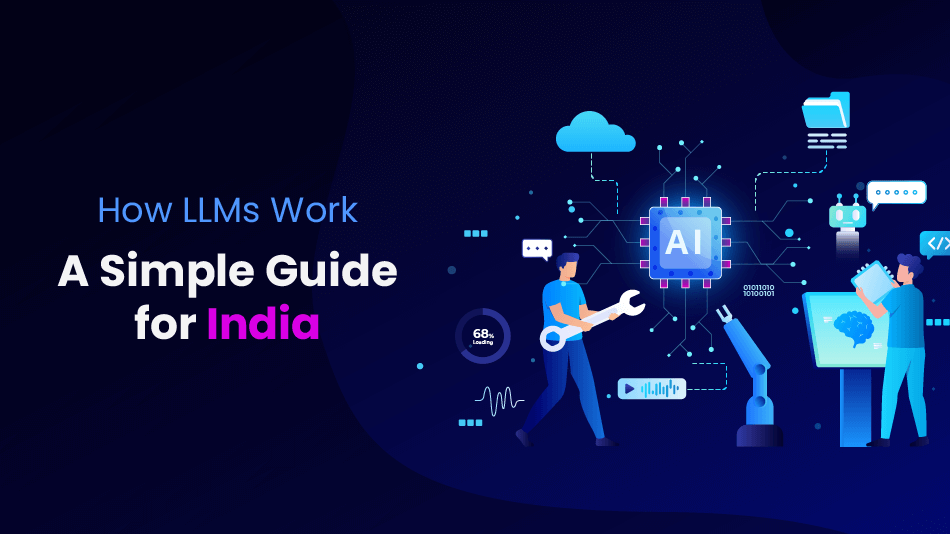
LLMs are kinda the brain behind most modern AI tools. Whether you’re chatting with a bot, asking for code help, or getting AI to write content — there’s usually an LLM in AI doing the job quietly in the background. It reads, learns, and predicts words just like how we talk, except it’s trained on billions of examples. Crazy, right?
Every time you use ChatGPT, Gemini, or even that AI writing thing on your phone, you’re watching how large language models works in real life. They’re not just tech toys anymore; they’re part of how we search, study, and create things online. From students writing essays to startups automating customer chats — LLMs make tasks faster and smoother.
Behind all this, what’s happening is that LLMs are turning text data into knowledge. They notice small patterns, meanings, emotions, and even humor. So, when you ask a question, it’s not just replying; it’s kinda thinking in patterns built from millions of lines of text. Sometimes it slips up — we all do — but most of the time, it nails it.
In short, LLMs are shaping how we connect with machines. Not as cold systems, but as smart buddies that get what we’re trying to say. And that’s what makes them super important right now — not just for tech experts, but for everyone who talks, types, or thinks online.
These models also help in Indian languages now. Hindi, Tamil, Bengali — you name it. Slowly, local teams are teaching them to understand our mix of English and regional slang. That’s a big deal because tech should sound like us, not just some fancy robotic script from Silicon Valley.
LLM vs Traditional AI Models
-
- Neural networks: Small data, short context
- LLMs: Huge data, long context
- Neural networks: Need manual tuning
- LLMs: Auto-learn and self-adjust
- Neural networks: Great for numbers
- LLMs:Great for natural language
Transformers vs Old Architectures
-
- Old models: Sequential, forgetful, slow
- Transformers: Parallel, focused, memory-rich
- Old models: Struggle with long text
- Transformers: Handle full pages easily
Key Components of an LLM
Every LLM in AI is like a mix of brains, memory, and language skills packed together. It’s not just one smart part but many tiny systems working quietly behind the screen. Let’s unpack the main bits that make an LLM tick.
Training Data and Dataset Size
Training data is what gives the model its knowledge. LLMs eat text like snacks — books, articles, chats, websites, even code. The bigger the dataset, the smarter the model gets.
It’s kinda like people: read more, know more.
Here’s what matters most:
- Quality of data affects how clear the answers are.
- Diversity of topicshelps avoid bias and repetition.
- Dataset size can range from a few GBs to terabytes of text.
Sometimes, a bit of noisy data slips in, but that’s how the model learns what not to repeat.
Parameters and Weights
-
- More parameters = more learning capacity
- Weights are like memory of what’s important
- Training adjusts these weights over time
Tokenization and Embeddings
-
- Tokenization splits the text into smaller units.
- Embeddings turn those tokens into numbers the AI can understand.
- It’s like giving every word a unique digital ID.
Attention Mechanism Explained
-
- Old models forgot that link
- Attention remembers it and keeps context intact
How LLMs Process Text Input
How Prompts Are Encoded
-
- Each word or phrase is converted into tokens.
- Tokens are mapped to vectors (numerical values).
- These numbers help the model “feel” the meaning.
Generating Tokens Step-by-Step
-
- It checks all possible next words.
- Assigns a probability to each.
- Picks the one that fits best with the flow.
Sampling and Output Generation
-
- The model selects tokens using probability and variation.
- Builds a full response word by word.
- Converts numbers back to readable text.
Common Types of LLMs
Decoder-Only Models (GPT Type)
-
- Work best for writing, chatting, and storytelling.
- Only use the “decoder” side of the transformer structure.
- Predict one token at a time in a flowing sequence.
Encoder-Decoder Models (T5, BERT)
-
- Summarization
- Translation
- Question-answering
- Paraphrasing
Multimodal and Hybrid Models
Now comes the cool group. These can read not just text but also images, audio, or even video. Yep, one model that sees, hears, and talks.
Some real-world uses:
- Image captioning
- Voice-based chat
- Text-to-image creation
- Multi-language support
Hybrid models mix old ideas with new transformer parts, making them flexible and lighter. Imagine an AI that can describe your photo, then answer questions about it — that’s multimodal power in action.
LLMs keep evolving, but these three types cover almost everything you see in today’s AI tools. Simple idea, powerful results.
Real-World Use Cases in India
Chatbots and Customer Support
-
- Handle thousands of chats at once.
- Understand messages written in Hindi, Hinglish, or English.
- Work 24×7 without needing a break.
Indian Language Translation and Learning
-
- Translating digital content for wider reach.
- Teaching English or regional grammar through chatbots.
- Supporting voice assistants in multiple Indian dialects.
Content and Code Generation
-
- Blog writing and social media posts.
- Creating marketing copies in regional tone.
- Generating code snippets or debugging.
Challenges and Ethical Concerns
As powerful as LLM in AI sounds, it’s not all perfect. These models face a few tricky issues that need some serious thought. From bias in answers to privacy worries, there’s still a lot of work to make them safer and fairer.
AI Bias and Hallucination
-
- Some replies sound unfair or one-sided.
- The model may favor certain regions, genders, or beliefs.
- It can misrepresent facts because of bad training examples.
Data Privacy and Local Laws
-
- Use of unverified or personal data during training.
- Lack of control over what data the model keeps.
- Data not always stored according to Indian laws.
How to Try or Use an LLM
Free and Paid APIs
-
- OpenAI’s ChatGPT for chatting and writing.
- Hugging Face for open-source models like Falcon or LLaMA.
- Google Vertex AI for professional use and data training.
- AI4Bharat for Indian-language-based models.
Tips for Better Prompts
-
- Be clear and specific. Say “write a short blog intro about LLMs” instead of “tell me about AI.”
- Use examples if needed. It helps the model match your style.
- Ask step-by-step questions when you need detailed info.
- Avoid super long prompts; keep it tight and focused.
The Future of LLMs in India
Local Language Models
-
- Projects like AI4Bharat and Bhashini are creating models for regional users.
- LLMs are learning slang, tone, and mixed-language text (like Hinglish).
- Ask step-by-step questions when you need detailed info.
- They’re helping rural areas access digital services easily.
Smaller and Efficient Models
-
- Lightweight models for mobile use.
- Low-cost training with limited data.
- Fast responses without heavy servers.
AI in Government and Education
-
- Chatbots for government portals.
- AI tutors for rural schools.
- Translation systems for multilingual regions.