When you’re building, you’ve got to think about Open Source AI Tools from the start. These tools give developers freedom, flexibility and control — yep, they’re the kinds of tools you’ll want in your toolkit. In this article we’ll talk about some of the best open source AI frameworks, developer AI libraries, AI development tools, machine learning open source platforms, and AI tools for software engineers. We’ll keep things simple (no heavy jargon), a bit casual (so you don’t feel you’re reading a research paper), and useful for everyday dev life.
Why open source AI matters for devs

Using open source AI tools gives you a few big advantages. First, you get transparency: you can see the code, tweak it, modify it. That helps when you want to adapt to your specific app or service. Built In+2DigitalOcean+2
Second, you often save cost and vendor-lock-in: you’re not tied to one commercial platform if you don’t want to be. DigitalOcean
Third, you join a community: many devs share tweaks, fixes, extensions so you benefit. But yeah, you’ll still face some challenges—documentation may be weaker, you might need to handle more plumbing. DigitalOcean+1
So if you are a developer who wants to build AI models, or integrate AI into your product, using open source AI tools (and the related keywords listed earlier) is a smart bet.
Key terms you’ll see in this guide
Here are some keywords we’ll sprinkle in naturally so search engines (and you) pick them up:
- Primary keyword: Open Source AI Tools
- Secondary keywords: open source AI frameworks, developer AI libraries, AI development tools, machine learning open source platforms
- Long-tail keywords: best open source AI tools for developers 2025, how to choose open source AI libraries for production apps, open source AI tools for machine learning engineers.
- LSI (latent-semantic) keywords: open source machine learning platforms, AI developer workflow tools, community driven AI libraries, free open source AI models.
You’ll see these coming up throughout the post.
What to look for when choosing open source AI tools
Before we list specific tools, you’ll want some criteria to pick from. Here’s a list of things devs should check (just some heads-up):
- License & openness: Make sure the tool is truly open source (MIT, Apache, BSD, etc). That means you can modify, deploy, distribute.
- Community & ecosystem: A big community makes a difference—plugins, support, tutorials, active improvements.
- Maturity & stability: Some open source AI frameworks are very mature, others still shaky. For production use you might pick the more stable ones.
- Performance & resource needs: Some tools need heavy hardware (GPU/TPU), others more modest. Pick according to your setup.
- Scalability & production readiness: If you’ll deploy to many users, you want a tool that scales and plays well in production.
- Documentation & ease-of-use: Some devs like minimal boilerplate and fast prototyping; some prefer deep control. Choose accordingly.
- Integration with your stack: Does it work with your language (Python, Java, JS, etc), your infrastructure (cloud, on-prem, edge)?
Using these, you can sort through the many options of open source AI tools for developers.
Top open source AI tools worth your time
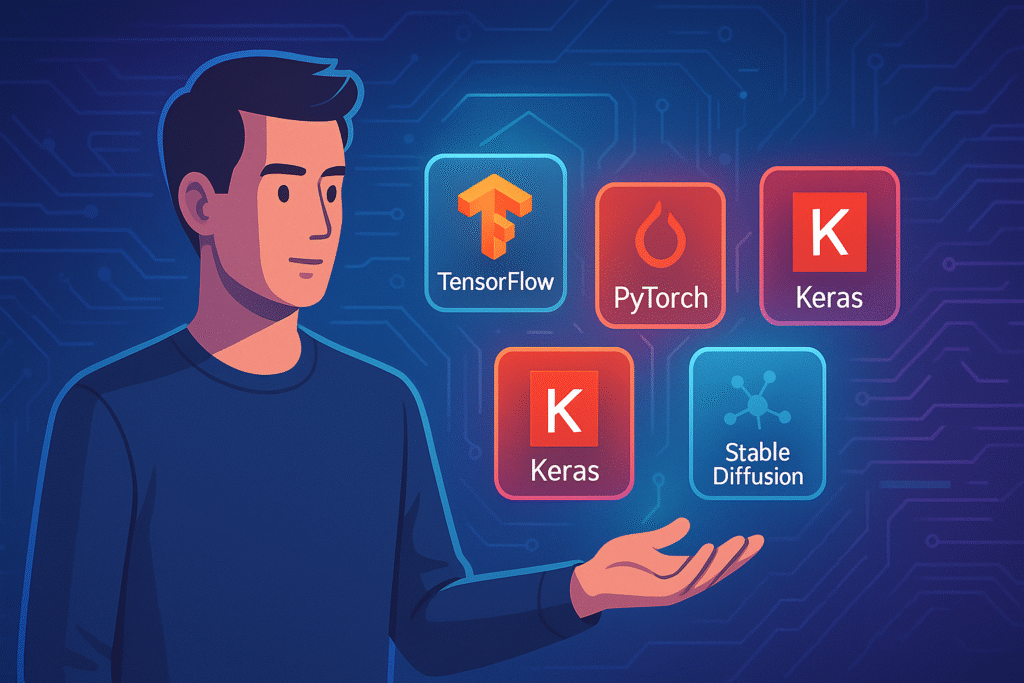
Here are some standout tools. We’ll cover what they are, why they matter, and some “for you” notes (what kind of dev or project they’re good for).
1. TensorFlow
Type: open source AI framework for machine learning and deep learning.
Why it matters: It’s one of the most widely used frameworks in the field. DigitalOcean+1
What you can do with it: Build neural networks, train models, deploy to mobile/edge/web.
For you if: You’re working in Python (or even JS), need broad ecosystem, need production-ready tools.
Heads-up: It can be more complex than simpler frameworks. But if you’ll go for scale, many devs pick it.
2. PyTorch
Type: open source machine learning library geared especially for research & prototyping.
Why it matters: Lots of devs prefer it for ease of use and flexibility. Wikipedia+1
What you can do: Rapid prototyping, dynamic graphs, custom experiments.
For you if: You iterate fast, maybe you’re in a startup or research mode.
Heads-up: For very large production systems you may need more tooling or handle scaling yourself.
3. Keras
Type: high-level neural networks API (often built on TensorFlow).
Why it matters: Simpler interface for deep learning; good for getting started. DigitalOcean+1
What you can do: Build models quickly, less boilerplate.
For you if: You’re newer to AI dev or want to build a prototype quickly.
4. OpenAI Gym
Type: open source toolkit for reinforcement learning (RL).
Why it matters: If you’re into RL, this gives environments + benchmark tasks. KDnuggets
What you can do: Try agents, train models in simulated environments, test RL ideas.
For you if: You’re working on robotics, game AI, or RL research/dev.
Heads-up: RL tends to need more compute and is harder to deploy than standard supervised ML.
5. Deeplearning4j
Type: open source deep learning library for the JVM (Java/Scala/Kotlin).
Why it matters: If your stack is Java/Scala, this gives you deep-learning capability without switching language. Wikipedia
What you can do: Neural networks, text/image processing on JVM.
For you if: Your app backend is Java/Scala and you want to embed AI directly.
Heads-up: The ecosystem might be smaller compared to Python-centric AI.
6. MindSpore
Type: open source deep learning framework developed by Huawei for AI and ML.
Why it matters: Provides interesting features, supports multiple platforms. Wikipedia
What you can do: Build models with Python syntax, deploy across devices.
For you if: You want to experiment with newer frameworks or target certain hardware.
Heads-up: Less documentation or community size compared to TensorFlow/PyTorch.
7. Stable Diffusion (via projects like ComfyUI)
Type: open source generative model + UIs.
Why it matters: For image generation (and related tasks) this shows how open source AI tools expand beyond “just text/classification”. Wikipedia
What you can do: Generate images from text prompts, build creative apps, integrate into pipelines.
For you if: You’re a dev working on creative tools, content, or generative workflows.
Heads-up: Generative models can be resource-intensive; consider deployment cost.
8. llama.cpp / scaling tools (via “what I learned from…” list)
Type: open source tools for model inferencing or optimisation.
Why it matters: The dev community is building tools that optimise large models, inference, memory, etc. Chip Huyen
What you can do: Take big models and run them on limited hardware, or customise for edge.
For you if: You want to push AI into edge/embedded devices or optimise performance.
Heads-up: These tools may require deeper tech knowledge and optimisation skills.
How to pick and mix tools for your workflow
Here’s how you might structure your workflow using these tools, and some practical tips.
Workflow idea: prototype → refine → deploy
- Prototype phase: Use PyTorch or Keras to quickly build and test your model.
- Refine phase: Move into TensorFlow (or production-ready framework) to optimise, add tooling.
- Deploy phase: Use the framework that fits your stack (JVM? then Deeplearning4j; mobile/edge? then decide accordingly).
- Generative/creative phase (if relevant): Integrate tools like Stable Diffusion or ComfyUI.
- Optimisation/edge phase: Use inference-optimising tools (like llama.cpp or other model compression/optimisation libraries).
Practical tips for developers
- Start small: pick one open source AI tool, get familiar.
- Check the community: are there active GitHub repos, issues, updates.
- Evaluate performance: some models are slow or heavy for your machine.
- Monitor licensing: ensure the licence allows your use case (commercial, modifications).
- Consider integration: how does this tool fit into your existing CI/CD, backend, frontend stack.
- Keep up with updates: open source AI evolves fast, new forks, improvements arrive.
- Document your choices: future devs/team will thank you.
Integrating these into your dev process means you’re using AI development tools and developer AI libraries in a structured way.
Use-cases and scenarios where open source AI tools shine
Here are some scenarios where using these tools gives big benefits — and when you might still choose proprietary tools instead.
When they shine
- You need custom models: your domain is niche, you need control.
- You care about cost and avoid vendor lock-in.
- You have access to dev talent that can tweak, strengthen, optimise.
- You deploy in unusual environments (edge devices, on-premises, hybrid clouds).
- You want to build trust/explainability: open source means you can inspect.
When you might still pick proprietary or closed tools
- You want very fast time-to-market and don’t want to manage infra.
- You need ultra-high stability, enterprise support, guaranteed SLAs.
- The tool you need is not yet well-supported in open source yet.
- You don’t have dev resources to manage/customise the open source stack.
In many real projects you’ll do a hybrid: open source tools for core parts, proprietary for plug-&-play features. The point is you know your options.
Common pitfalls to avoid
When you pick open source AI tools for developers, you’ll want to watch out for these common mistakes:
- Picking a tool only because it’s “open source” but ignoring community size or documentation.
- Underestimating infrastructure: some frameworks need GPUs, clusters, etc.
- Ignoring the integration cost: how the AI tool fits into your backend, how you deploy it, maintain it.
- Forgetting optimisation: in production you’ll care about model size, latency, memory, scalability.
- Assuming every open source model is secure or bias-free: you still must validate models in your domain.
- Letting the tool become a “black box”: you lose the benefit of openness if you treat it like a black-boxed proprietary API.
If you avoid these, you’ll be in better shape.
Real-world mini case: a web service that uses open source AI tools
Let’s say you’re building a web app for image captioning (you have photos, you want to provide auto-captions). Here’s how you might apply this:
- Choose a backbone model from an open source library (say using PyTorch and a pretrained image model).
- Use an open source AI framework for fine-tuning the model with your photos + domain captions.
- Use a UI built with your web stack (e.g., Node.js, Django, etc) and integrate the model inference.
- Deploy using an optimised framework for inference (maybe convert to TensorFlow for serving, or use tools like llama.cpp if you go edge).
- Use a library or tool for image generation or manipulation if relevant (e.g., generative UI).
- Monitor metrics: latency, accuracy, error rate, feedback from users.
- Iterate: fine-tune, update model, push improvements.
In that flow you used open source AI frameworks, AI development tools, developer AI libraries, which is exactly what using open source AI tools means in practice.
Future of open source AI tools
The landscape is shifting. The article “What I learned from looking at 900 most popular open source AI tools” shows that devs are building lots of niche tools (model merging, optimisation, inference speed-ups). Chip Huyen
Also, open source AI is more recognised in enterprise settings now. ibm.com
What that means for you:
- Expect more tools that simplify deployment, edge/embedded usage.
- More libraries that integrate with developer workflows (IDE plugins, dev-ops, CI/CD for AI).
- More community-driven innovations (models, data sets, tooling).
- More need for devs to know not just “build a model” but “deploy, monitor, maintain” with open source stacks.
So pick your tools now, build skills, you’ll be ahead.
Summary / wrap-up
You have now a good overview of Open Source AI Tools — what they are, why they matter, how to pick them, and some leading options: TensorFlow, PyTorch, Keras, OpenAI Gym, Deeplearning4j, MindSpore, Stable Diffusion/ComfyUI, llama.cpp-type tools.
Pick tools that match your stack and dev goals, focus on integration and real-world production issues. Use the keywords we listed naturally in your projects and docs: open source AI frameworks, developer AI libraries, AI development tools, machine learning open source platforms, AI tools for software engineers.
If you build your next app or feature using one of these and handle deployment, monitoring and maintenance, you’ll be well-positioned.
Thanks for reading and happy building with open source!